The Art of Naming Color
How would you describe a color to someone who had never seen it?
You might point to a goldfinch’s wing. Or a jasmine blossom.
More than two hundred years ago, that was part of a wonderfully thoughtful approach to naming color—and it’s the story behind some of our newest finds for The Paper Studio.
Giving color a name
“Nomenclature” is simply a system of names. For someone trying to record the natural world, naming a color precisely was a practical challenge. How could you describe the blue of a feather or the yellow of a flower so that someone elsewhere would know exactly what you meant?
First published in 1814, Werner’s Nomenclature of Colours offered a shared vocabulary. Scottish botanical illustrator Patrick Syme built on the color system of German mineralogist Abraham Gottlob Werner, pairing painted swatches with examples from the animal, vegetable, and mineral kingdoms.
The result was both useful and wonderfully evocative. Gamboge Yellow could be found in a goldfinch’s wing or yellow jasmine. Prussian Blue had a reference in the blue patch on a mallard’s wing. The book invited its readers to find color in the world around them.
Charles Darwin used the 1821 edition during his voyage aboard HMS Beagle. Those swatches helped turn a fleeting observation into something another person could understand.
The simple pleasure of swatching
I have completely come to love watercolor. This is not a claim to any particular talent—I simply enjoy it. I find it relaxing, absorbing, and a very pleasant way to spend some time with a brush and a page.
I got started through some of the watercolor books we sell at Clever Girl. And one of the most pleasurable things I’ve discovered is something called swatching.
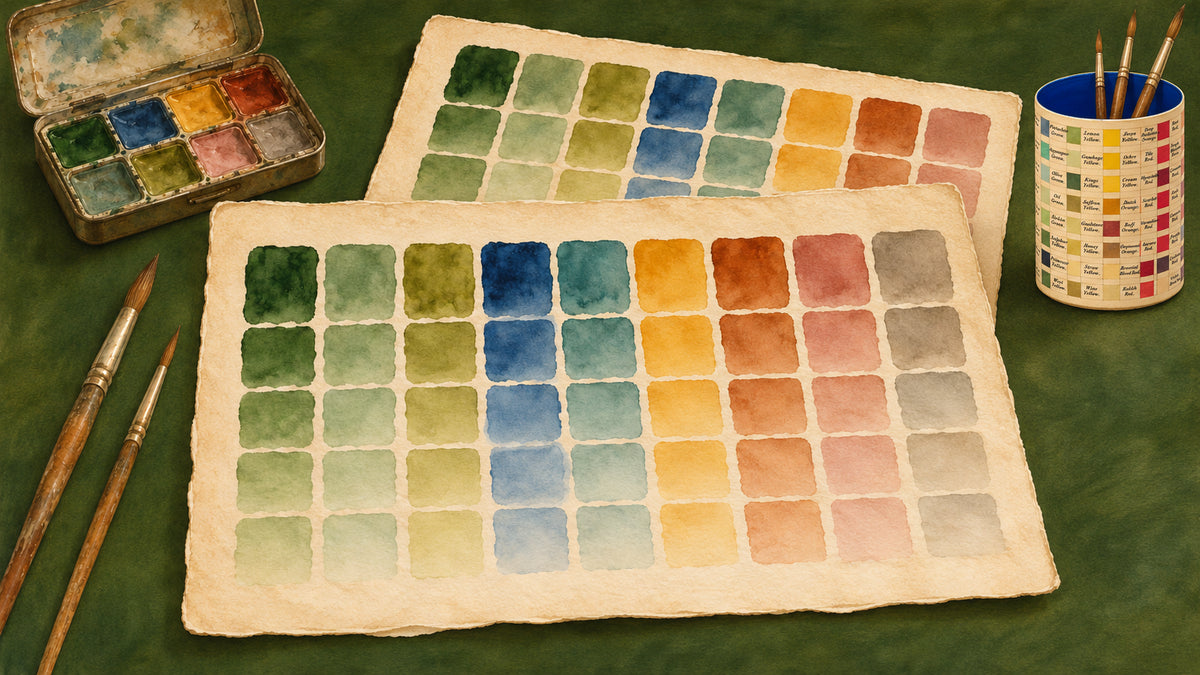
You open a new box of paints and try a bit of each color on paper, getting acquainted with how it actually looks on the page. Add more water and a strong color softens into a delicate wash. Use less and it becomes richer and more intense. There is something incredibly satisfying about watching those differences appear, one swatch after another.
Sometimes that is enough: a page of colors, a bit of experimenting, and the pleasure of seeing what happens.
Roomytown’s gorgeous nomenclature pieces remind me of that simple pleasure: the colors arranged side by side, each with its own character, and the invitation to stop and really look.
From natural history to the everyday desk
Later in the nineteenth century, American ornithologist Robert Ridgway also worked to make descriptions of color more precise. His 1886 color reference helped standardize descriptions of birds. Its beautifully ordered swatches provide the artwork for several of the Roomytown pieces we’ve chosen.
Roomytown’s design studio is in Bath, England. The team searches out historical artwork in old books, museum archives, and vintage finds, then reworks it for objects we can use every day. That sense of discovery is very much at home at Clever Girl: something catches your eye, and its story gives you another reason to love it.
Our selection brings together two chapters of that color history. The enamel pot draws on Werner’s Nomenclature as published by Syme in 1821; the sketchbook, playing cards, and jotter draw on Ridgway’s later studies.
An enamel pot with a history
Handmade by artisans, the Enamel Everything Pot wears an adaptation of the 1821 color swatches. It’s a beautiful place to gather pens, pencils, or paintbrushes—and keep a bit of that history close at hand.
Shop Enamel Everything Pot - Werner's Nomenclature of Colours

A sketchbook for your own experiments
The Artist Sketchbook pairs Ridgway’s color studies with mixed-media paper, a fabric-covered spine, and a ribbon closure. Its cover is an invitation to open it and begin.
Shop Artist Sketchbook - Ridgway's Nomenclature of Colors

Color for the daily list
The Nomenclature of Colors Jotter Block carries Ridgway’s palette around the edges of its perforated sheets. Even sitting on a desk, it gives you something lovely to look at between notes.
Shop Jotter Block - Nomenclature of Colors

A very colorful hand of cards
The Nomenclature of Colours Playing Card Deck turns Ridgway’s swatches into a full deck of individually designed cards, tucked into a pull-drawer box. A satisfying gift for a color enthusiast, with no paintbrush required.
Shop Nomenclature of Colours Single Playing Card Deck

For the pleasure of it
These would make thoughtful gifts for someone who paints, someone who would like to begin, or anyone who finds a box of colors hard to resist. A sketchbook and a pot for brushes make a lovely pairing. The jotter brings color to the daily list; the cards bring it to the table.
And if you’ve been curious about watercolor yourself, perhaps start where I did: with a book, a box of paints, and a few swatches. Try the same color with a little more water, then a little less. See what lands on the page.
You don’t have to make a masterpiece to thoroughly enjoy making something.
—Katie


Leave a comment
This site is protected by hCaptcha and the hCaptcha Privacy Policy and Terms of Service apply.